
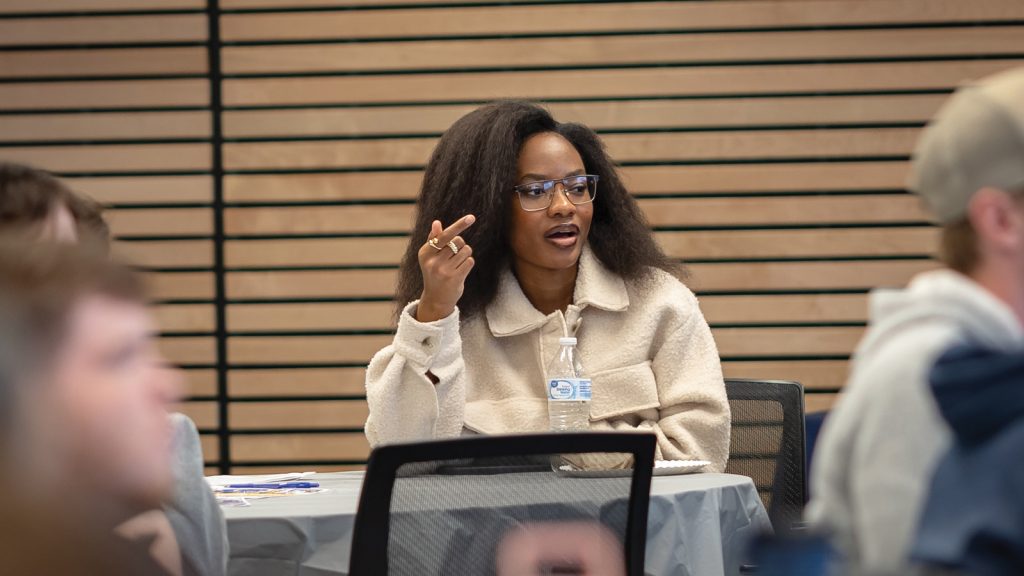
As a Columbia College senior majoring in finance, Prisca Akonkwa has spent the past three years inside classrooms, learning from textbooks, case studies, and lectures. This past January, she took the opportunity to gain real-world business experience as a student consultant with Columbia College’s Aspire Business Clinic.
“When you’re working in class, you have presentations for your professor and classmates, but in a business, you have to understand the expectations of the person you are working with, so that was very different,” Akonkwa says. “In this program, it pushed me to go deeper than what I learned in school.”
Experiential learning for today’s students
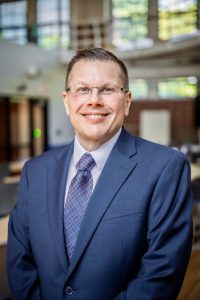
The Aspire Business Clinic officially kicked off during fall semester of 2024 with the goal of introducing students to the world of business consultancy, says Bob Hohenstein, visiting professor of business administration and the clinic’s director.
“Students today want experiential learning, and they want real-world skills,” Hohenstein says. “They don’t want to just be lectured to in a classroom; they want to be prepared to go into the workplace ready to go, and most employers want employees they bring on board to be ready to go on day one.”


As other institutions of higher learning around the country add experiential learning components to their offerings, Hohenstein notes that the concept of a clinic — essentially functioning as an in-house consulting firm — was a practical way to give students the opportunity to put their skills to work in the real world. It also seemed like a natural fit for Columbia College.
“After our dean, Dr. Jon Moberly, executed a similar program in his previous position, we felt it was something that needed to take place and that it would be a viable clinic given the number of small businesses in Columbia, both for-profit and nonprofit,” Hohenstein says. “We began foundational work in the fall of 2024 and began actual work with clients in the spring of 2025.”
Welcoming students from across Columbia College
There are three ways that Columbia College students can become a part of the Aspire Business Clinic. The first is through student employment. Students seeking a part-time position on campus and hoping to work in the clinic go through the same process as any student seeking an on-campus position.
“They submit their credentials to the human resources department, have a personal interview, and a decision is made,” Hohenstein says.
The second is through an academic internship. While students are paid for the hours they work, an intern submits work to be reviewed and graded by the college. They then earn academic credit toward their degree.
The third way students come to Aspire is through enrollment in Management 350, a Hohenstein course that is known as “The Business Clinic.”
“The course gives students insight into what a business consultant does,” Hohenstein says. “We review what a business consultancy is set up to do, what its goals are, its ambitions, and what you can expect as a business consultant.”
Hohenstein notes that while enrollment in Management 350 is not currently a prerequisite to participation in the Aspire Business Clinic, it could become one at some point in the future.
“There is every possibility that it will be a requirement moving forward, so students have the background,” Hohenstein says. “They won’t just be walking in not knowing what it is or what our purpose is. The course will give them a better background into what a business consultant does.”
While students can connect to Aspire in three different ways, Hohenstein says there is “no limit to the skill level or talent we take.” The clinic accepts students from all disciplines at Columbia College.
“You don’t have to be in business,” says Hohenstein. “We need that extra piece that students may have from nursing, cybersecurity, one of the arts and sciences, biology. We try to be as open as possible as to who we invite to the clinic, and we really want as many students in the clinic as we can that make sense and can bring value to the clinic and our clients.”
Bringing value to Central Missouri businesses
Hohenstein notes that the clinic is also open to the types of businesses it works with.
“We want a good blend of for-profits and nonprofits that have a range of problems that they need solved or need help with,” Hohenstein says. “The goal is to get small businesses within central Missouri, preferably in Columbia or within Boone County.”
Participation in the program is free to businesses.
“Most businesses can’t afford an apprenticeship program, and there is no charge for the consultancy at all,” Hohenstein says. “We understand that the prospective client is a small business that doesn’t have the resources to pay a consultant, and this clinic can really help a student understand what to expect when they get into the business world. … The purpose of the clinic is not to generate income for the college, but to provide students and businesses an opportunity to work together to provide something that is beneficial for the student and the client.”
Putting skills to the test
After beginning work with the Aspire Business Clinic this past January, Akonkwa says she had the opportunity to work with fellow students as part of two business consultancies for two different local clients, a flower shop and a counseling center. While the projects were very different, they both allowed her to translate the skills she had been learning in the classroom to a professional environment.
“An internship or working in the real world always brings more skills than you learn in class,” Akonkwa says. “I learned about working in a team, being organized, and I just learned a lot about professionalism, which I don’t really get in class.”
At the flower shop, she helped create a budget to match the company’s goals and assessed whether proposed marketing ideas worked within that budget.
“It was also coming up with new ideas because they wanted to expand in other areas,” Akonkwa recalls. “I learned that finance is not just about numbers when you’re working in a business. You need to consider the reality of the business and other businesses in town and consider other aspects like branding and marketing. They are all important, and you need to look at all of them before coming up with a budget or a financial analysis.”
As she prepares to graduate in December, Akonkwa has her eye on graduate school.
“After grad school, I’m thinking about going back home to Congo,” Akonkwa says. “I always wanted to have a consulting firm in my home country and help small businesses or businesses that are in rural areas.”
She admits that her first experience working off campus with a real business was stressful at the beginning, but she has gained so much confidence in her professional skills.
“This program will help me when I go to grad school because I’ll have a better understanding of all the courses I had,” Akonkwa says. “When I go back to my home country, I will already know how it works and all the things I need to consider when working.”
Aspiring to grow
Aspire has had five student consultants to date, and Hohenstein is now focused on expanding the program to include both more student consultants and more local clients.

“One of my goals is to grow the Aspire Business Clinic to the point where, hypothetically, we can’t take on any more clients,” Hohenstein says. “Another goal is for this to be a year-round thing because business problems don’t go away in the summertime. You don’t walk out the last day of spring semester and forget about it until the first day of fall semester.”
The confidence and understanding that come from collaborating with working professionals can’t be overstated, and while the hope is that business owners may eventually become mentors, Hohenstein notes that pushing students outside of their comfort zone is one of the secrets to the clinic’s success.
“The Aspire Business Clinic puts students in professional environments that may not be very comfortable, where they’re dealing with business professionals who are working to put food on the table,” Hohenstein says. “It’s serious business to our clients, and it gets the student out of his or her comfort zone, where they have to dig deeper.”