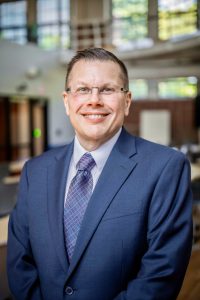


Barely three minutes into his inauguration speech, Toby Arquette referenced Columbia College’s upcoming bicentennial – in 2051. It’s that kind of forward thinking that convinced the Board of Trustees that Arquette was the right person to become the college’s 19th president.
“He is the leader for this time,” said Anita Abbott Timmons, board chair and a 1958 graduate of Christian College. “He is a leader who places students at the heart of every decision.”
Faculty, staff, students, trustees, alumni, and community leaders gathered Friday in Launer Auditorium on the college’s main campus for the inauguration ceremony, which served as the capstone of the college’s yearlong 175th anniversary celebration. The day also featured the dedication of the Jane Froman Smith and Carol Ann Peck Music Program, Academic School Showcases and the annual Homecoming Festival.
Columbia College: Built on Bold Beginnings
Arquette, who has been on the job since March, described the college’s relationship with its students as a covenant — a promise renewed by each generation. From its founding in 1851 as Christian Female College to its expansion into military education, adult learning and online offerings, Columbia College – the institution’s name since 1970 – has continually adapted to meet learners’ needs while remaining centered on student success, he said.
“A covenant is a promise that outlives the people who made it,” Arquette said. “For 175 years, the people of Columbia College have carried this one forward, and now it’s ours to keep.”
As president, Arquette outlined three priorities: keeping student progress at the center of the College’s work, sustaining an education grounded in academic rigor and human connection, and strengthening the institution for future generations.


As an undergraduate, Arquette was a first-generation student, and he now leads an almost 50 percent first-generation student body at the Columbia campus, according to the College Index.
He came to Columbia with his husband and now First Gentleman Mark Oberle but spent little time over the summer in his new home. Instead, he made a point of visiting every Columbia College campus, getting to know the students and faculty through more than just the brochure.
In addition to his presidential responsibilities, he teaches a first-year seminar to help ease new students through the transition to college.
‘Shared Stories Across History’
Provost and Executive Vice President for Academic and Student Affairs Sandra Hamar said during the inauguration ceremony that the 100,000 Columbia College alumni speak to shared stories across history. She also pointed out that Columbia College has 100,000 alumni and 20,000 students who are enrolled across 15 campuses, military bases, and online courses.
“Each graduate carries a piece of Columbia College into the world. And the world is better for it,” Hamar said. “Our legacy is measured in people and the lives they touch. It is our responsibility to not simply preserve that legacy. It is to extend it.”
She noted that when Arquette arrived on campus seven months, the college was prepared “for something like a ride on a jet.” She described the expected ride as “a fast climb, with a little G-force, some turbulence, and plenty of speed.”
“Instead,” Hamar said. “We find ourselves on a rocket shop.” She credited that to Arquette’s “astronomical ideas and your pace at which you pursue them.”
Timmons echoed those thoughts in her remarks, explaining that she has watched nine presidents preside over her alma mater.
“Each of them brought fresh eyes to this institution, along with their own backgrounds and unique experiences,” she said. “They brought a new vision of what higher education would look like during their tenure. I have watched my alma mater change and change again. And yet, stay majestically the same.”
‘The Leader for This Time’
What makes the Arquette era especially timely, Timmon said, is that “there are as many challenges in higher education today than there have ever been.”
“The journey forward calls for the right leader to chart our course as we forge our future,” she said. “It was clear to the search committee and to the approving board of trustees that Dr. Arquette was the leader for this time.”
Timmons and vice chair Joe Nicchetta (1979) formally installed Arquette, presenting the college mace, presidential medallion, and a copy of the institution’s original January 1851 charter.
When Arquette took his turn at the speaker’s podium, he explained that he was the first in his family to attend college.
“I almost didn’t. I come from a family of people who served, many of them in uniform, and that was going to be my path too,” he said. Then … a chance encounter with a college professor named George.
“It changed everything,” Arquette said. “He saw something I hadn’t yet seen in myself, and he decided I belonged in college.”
Arquette said the professor helped him open the door, walk through it, then navigate each step from his undergraduate years to law school, and finally to his doctorate.
“Sadly, George passed away before he could see this day. But he’s the reason I’m standing here,” he said. Arquette said that experience gave him to resolve to “pay it forward” with the students who are taught, including “the potential we recognize, and the people we stand beside while they find their way.”
Charting a New Course
The first part of his trek at Columbia College was a summer journey to see all of the college.
“I wanted to see the real one, not the brochure,” Arquette said. That journey took him from Oklahoma and Texas to Colorado and Washington State, and many places in between “and everywhere I went I found people helping students make room for an education in lives that were already full: jobs, families, military service and the determination to finish what they started.”
The year of celebration and the week of reflection now shifts the focus to the next milestone: Columbia College’s bicentennial in 2051. In 1851, Arquette said, Columbia was “a small town at the edge of the frontier,” and a group of families bucked common social norms to create a place where their daughters could receive the same education as their sons: Christian Female College, the first women’s college west of the Mississippi chartered by a state legislature.
In 1970 the college changed its name to Columbia College, opening its doors to men. In the years that followed, the college went to students: to military installations across the country and to evening classes for working adults who couldn’t come during the day. In 2000, the college launched online classes, well before most colleges took online learning seriously, Arquette said.
“Each move took nerve,” he noted. “Each came before most of higher education was ready to follow. And each kept the same promise in a new way … It’s the one we renew every time a student enrolls. Think of a family sending an 18-year-old across the state. A spouse taking on more at home so a partner can study at night. A parent paying tuition with money set aside for something else. They are trusting us with something precious.”
Changing With Changing Times
As he formally acknowledged his inauguration, serving as the college’s 19th president is “the privilege of my professional life,” he said, pointing out that the ongoing promise of student-centered education “has to fit the world our students are entering, not the one we grew up in.”
Harbingers of change abound. For instance, he said, the World Economic Forum estimates that by 2030, nearly 40 percent of the core skills employers need will change.
“The covenant we make with an 18-year-old has to hold up across every one of those jobs,” Arquette explained.
And there will also be “hard questions” in health care, education, business, and public life, and communities will need people “who can examine evidence, solve problems, and demonstrate civility and respect.”
“So our students deserve preparation for meaningful work and the capacity to keep learning as that work changes,” he added. “They should learn to use powerful tools like artificial intelligence wisely, and still bring what no machine can: judgment, character and care for other people.”
Arquette joined Columbia College from St. Ambrose University in Davenport, Iowa, and began serving as president in early March. He finished his education with a doctoral degree in communication from Northwestern University.
“Somewhere, a future Columbia College student is waiting for someone to recognize their potential,” Arquette said in his acceptable speech. “They may be the first in their family to go to college. They may be serving their country, raising a family or wondering whether it’s too late to begin again. And in 2051, they may stand at this podium and tell us how the people of Columbia College changed the direction of their life.”