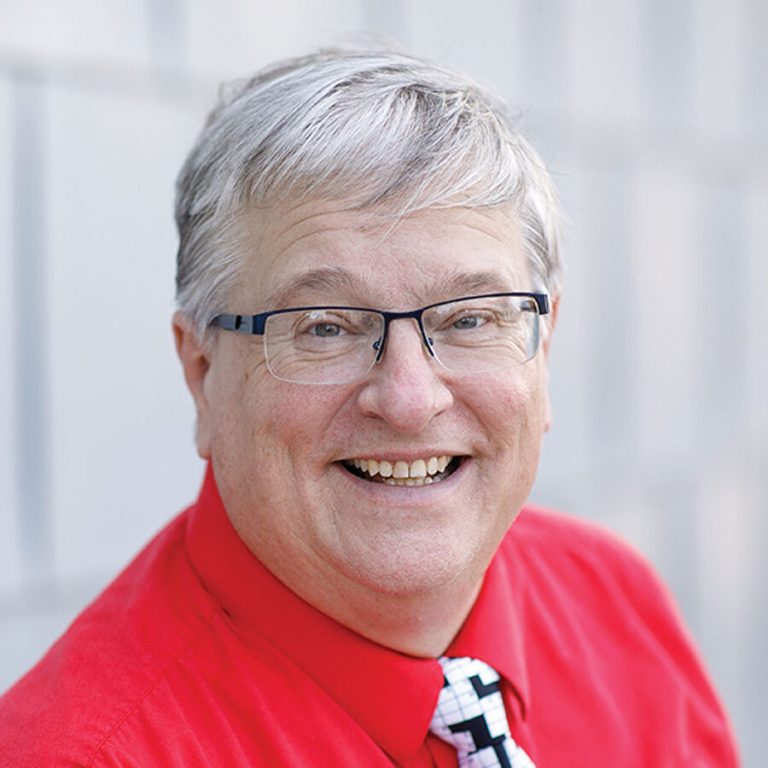


Abdul-Kaba Abdullah brings his solution-oriented background to Columbia’s Chamber.
Distinguished.
Accomplished.
Premier leader.
Problem solver.
Convener.
Those are just a few of the superlatives colleagues and fellow collaborators have used to describe Abdul-Kaba Abdullah, who has now been in the role of president and CEO of the Columbia Chamber of Commerce since July 1. And the emotive descriptions, some gleaned from social media announcements about Abdullah’s rise and leadership on the St. Louis area economic development landscape, go even further. And bolder.
“Confident. Swagger. Louder than the rest.”
Those who didn’t meet Abdullah in his first two-and-a-half months on the job got a clear view of those qualities when he took the microphone at the Chamber’s September 9 quarterly membership breakfast.
“I’m not your traditional Chamber executive. I wasn’t the traditional economic development president. I wasn’t a traditional city manager,” Abdullah told more than 400 attendees in the conference area in the new north end zone facility at Mizzou’s Memorial Stadium. He quickly pointed out that the community’s top movers and shakers, from city leadership and the business community to university officials, economic development professionals, and other civic leaders, were present.
“I’m not just interested in doing events,” he said. “What I’m interested in is how to solve issues, how do we solve problems, and how do we put skin in the game to move this city forward.”
Abdullah insisted that all of Boone County and the leaders in city and state government in Jefferson City are also players in “convening” to address issues and to make the region, not just Columbia, “even better.”
“There’s an obligation the Chamber has to be in the forefront of that,” he said. “I’m asking all our partners to help us come up with a larger strategic plan for economic development which will get everyone going in the right direction.”
As he took over leadership of Columbia’s 121-year-old, nearly 1,000-member Chamber, Abdullah brought more than two decades of experience in economic development and community revitalization. He most recently served as executive director of Park Central Development (PCD) in St. Louis, where, according to published reports, he helped facilitate more than $1.3 billion in investment and led revitalization work across 15 neighborhoods. Abdullah also previously served as city manager of Berkeley, Missouri, where he helped drive the city’s largest economic growth in more than 30 years, according to news reports.
“I wasn’t in a position where I needed a job. I was very happy” in the nine-year stretch of service with PCD, he said. “We were accomplishing great things from a community development standpoint.”
The commercial districts in that area, which included The Grove — the original Central West End neighborhood that included Washington University Medical Center and the Botanical Gardens — experienced more than a billion dollars in retail sales, and the development corporation completed some $200 million in infrastructure projects that included lighting and sidewalks.
“I woke up every day as the day-to-day person on the ground with the responsibility to see that the sidewalks were fixed and that our businesses had the resources they needed,” Abdullah said. He said that economic development, housing stability, and wealth building are best accomplished block by block, corridor by corridor, and neighborhood by neighborhood.
“That’s the secret sauce for the growth of those neighborhoods,” he said.
But what convinced Abdullah to answer the call of the Columbia Chamber’s posting for a new CEO and president?
“A growing population. Columbia has that,” he said. “That’s always a sign that people want to be there, want to come there.”
“I’m asking all our partners to help us come up with a larger strategic plan for economic development which will get everyone going in the right direction.”
He was also sold on the sense of ownership that he observed — and continues to see — among businesses and residents.
“There’s something that is unique here. It’s the people. People love Columbia,” he said. “You look at the type of commitment that I’m seeing — not just businesses, but residents — and how everyone has come together to say, ‘Hey, we’re going to all come to the table to make consensus and have that rising tide lift all boats.”
While Abdullah, a voracious reader and writer, as evidenced by his LinkedIn posts, is prone to using notable quotes and phrases to emphasize his thoughts, those aren’t platitudes.
“For me, coming into this space, it was a change, an opportunity around having more say around business development and how cities can move forward in this day and age,” he said. He readily concurs that the Chamber position was also a career advancement where he can sharpen his skills and “take advantage of other skills that I have.” It’s in that light that he sees the opportunity for the Chamber to become more regional.
“It’s coming into a space where I have done some form of this work,” Abdullah added. “It’s something from an economic development standpoint that I didn’t see in St. Louis.”
Abdullah graduated from Mehlville High School in St. Louis in 1997. In November 2020, he was inducted into the Mehlville School District Alumni Hall of Fame. The social media post making that announcement noted that Abdullah “has devoted his career to improving the lives of those living in St. Louis, especially in his current role as executive director of Park Central Development. He also takes the time to mentor youth and participates as a community volunteer.”
The St. Louis Business Journal called him “one of the premier, young civic leaders in the St. Louis region.” Prior to his appointment as executive director at PCD, Abdullah served as the Berkeley city manager, where in 2016 he was named one of the 40 Under 40 by the journal for his work in the region. In 2015, he was recognized by the St. Louis American Newspaper Foundation for his accomplishments in management in municipal government and reform. He also served the city of St. Louis in the Affordable Housing Commission and Better Family Life as assistant manager of workforce development.
He is a graduate of Northwest Missouri State University, where he was honored with the Distinguished Young Alumni award, and holds dual master’s degrees in Total Quality Management and management from Webster University.
Adbullah’s resume, street cred for community and economic development, and his vision for expanding the Chamber’s role made his name prominent throughout the Chamber board and selection committee’s quest for a new leader. Board President Matt Jenne, owner of Sophia’s and Addison’s restaurants, said the national firm that led the search “did an amazing job finding people who were qualified and fit the criteria we were looking for.”
There were roughly a hundred applicants, which were whittled down to a list of 20, and then 10 finalists who were interviewed.
“Abdul, every single time, came to the top,” Jenne said. “The tools he brings to our community and to our Chamber were exactly what we were looking for.”
Abdullah’s predecessor, Matt McCormick, left for a similar position at the Ocala Metro Chamber & Economic Partnership in Ocala, Florida. During McCormick’s tenure, the Chamber launched initiatives to support workforce development and business growth, helped guide businesses during and after the COVID-19 pandemic, and started the popular Leadership Visit program.
“What I think the board was looking for was a Chamber that is a little more active and out front in how we can solve problems,” Jenne said. “Under Matt, that was the direction the Chamber was going — being more strategic when it comes to how to attack the problems we are having in our community. And that’s what our businesses want.”
Those problems include the hot button issues of public safety, especially in the downtown area, homelessness, workforce development, and affordable housing, among others.
In mid-September, Abdullah organized a trip for business and community leaders to visit the Central West End of St. Louis, where leaders there have developed strategies to address those issues.
“Not only is he able to bring people together, but he is also able to offer solutions” based on what he has seen in St. Louis, Jenne said. “Right off the bat, he has shown he has that tool set.”
Abdullah told the Chamber breakfast crowd on September 9 that he is interested in having conversations “where we come together and be very solution-oriented … that we don’t just bash each other over the head” over problems that he said are “very solvable.”
As with finding solutions for homelessness and affordable housing, Columbia is also not immune to the sometimes unpredictable ebbs and flows of the economy. That’s why, Abdullah said, the Chamber’s role in communicating and educating its members, as well as the general population, is especially crucial.
“Progress moves at the pace of trust. If people trust you, if people know you, it creates more opportunities. That’s why we need to focus more on relationships.”

“Are we being a conduit [of information] so they feel involved? Are we lifting all voices?” he questioned. “A confused mind says ‘no.’ How do we get residents, the business owners, the entire community to a place where it’s a ‘yes’” on collaborative problem-solving?
Abdullah also places an additional duty on himself, saying he is an ambassador for Columbia. And that has everything to do with building relationships and listening.
“That’s part of my DNA,” he said. “To be an ambassador not just for the Chamber, but to be an ambassador for the city.” To that end, Abdullah has already become a common face at ribbon-cuttings, open houses, and other public events.
“When you are in certain positions, there are certain expectations — and there should be — that you’re accessible to people and the businesses,” he explained. “Progress moves at the pace of trust. If people trust you, if people know you, it creates more opportunities. That’s why we need to focus more on relationships.”
It’s also an integral part of public service, which Abdullah decided to make his career after one of the most pivotal moments in American history.
He shared that story in a LinkedIn post on September 11.
“As the day ends, I am reflecting on this day — 9/11/2001 — I was working on the Hill as an intern in D.C. for Congressman Chaka Fattah. I remember watching the second plane hit the towers, then CNN breaking in, saying, “The Pentagon has been hit! The Pentagon been hit!
“Then Congressman Fattah came out and said, “Everybody get the hell out of here!” We ran out of the Rayburn Office Building amid chaos and military securing the Capital complex, with F-18s flying fire cover over our nation’s capital. It was my first time ever being afraid in my adult life.
“D.C. shut down; it took me 11 hours to get home because of the chaos. This started my path of public service — and what a great journey it has been.”